I was reading an article from a fellow blogger and cyclist,
David Hembrow, on the
3 levels of safety when riding a bicycle.
- Actual Safety - How many km or miles you can expect to travel before you're injured on your bike.
- Subjective Safety - Are you near a fast moving traffic? Is it easy to make a turn across traffic? Do you have to cycle "fast" in order to keep up?
- Social Safety - Is there a mugger around that blind corner? Will I be attacked in the street if I cycle?
What intrigue me about the article, among many things, was how Mr. Hembrow was able to express my sentiment about why helmets won't make me feel safer while cycling but cycling in midtown does. Not to say that the streets of Sacramento are completely safe. In fact, I rode on 19th St. to Landpark yesterday, and although the path was clearly marked as a bike lane and there were signs inviting the drivers to "share the road," no one seem to care or even noticed that there were cyclist near by, given their speed and how close they came to my poor "Sofia" (my gorgeous electra cruiser) and I.
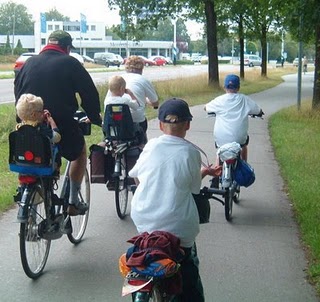
In his blog "A view from the cycling path", Mr. Hembrow explains that if subjective and social safety improves then people will want to cycle. The reason why so many Dutch take up cycling and feel safe, is because the result of their successful campaigning for the design of the road conditions. He adds, that Dutch cyclist are safer without the subjective safety wear, namely reflective clothing and helmet, than their counterparts in other countries around the world.
His article was extremely interesting and I highly recommended as a very good read. Amazingly enough, he received a comment from a USA resident disagreeing with him in the non-helmet use, city that "over the past six years he has fallen and broken two helmets." Here is Mr. Hembrow's response:
"I am not against you wearing a helmet if you feel happier with one. If it reduces your perceived risk such that you ride your bike, then that's good. However, please recognize why you wear it.
It's got very little to do with cycling being dangerous in and of itself.
There is no reason why cycling needs to be any more unsafe than a lot of the other activities that you and I take part in every day without a helmet. These includes walking, climbing stairs, riding in automobiles...
The justification for a helmet for bicycle use only is one of compensating for the risk (or perceived risk) around you due to your local environment, not of compensating for any inherent risk of cycling.
While cycling is genuinely much more dangerous in the US than it is over here, that is due to other factors, such as a car oriented design of streets and driver behavior, not due to any inherent danger or riding on two wheels."
In the USA the onus is always on the cyclist. We could do well to learn from the Dutch that have improved their roads to create the safety that is require to improve cycling experience. We could also educate the driver to look for the cyclist. The wearing of a helmet does little to create actual safety, on the other hand, the teaching of the community at large (specifically drivers) and the improvement of the design of our infrastructure does.